SF71The Signal Archive

On air / Edition 001

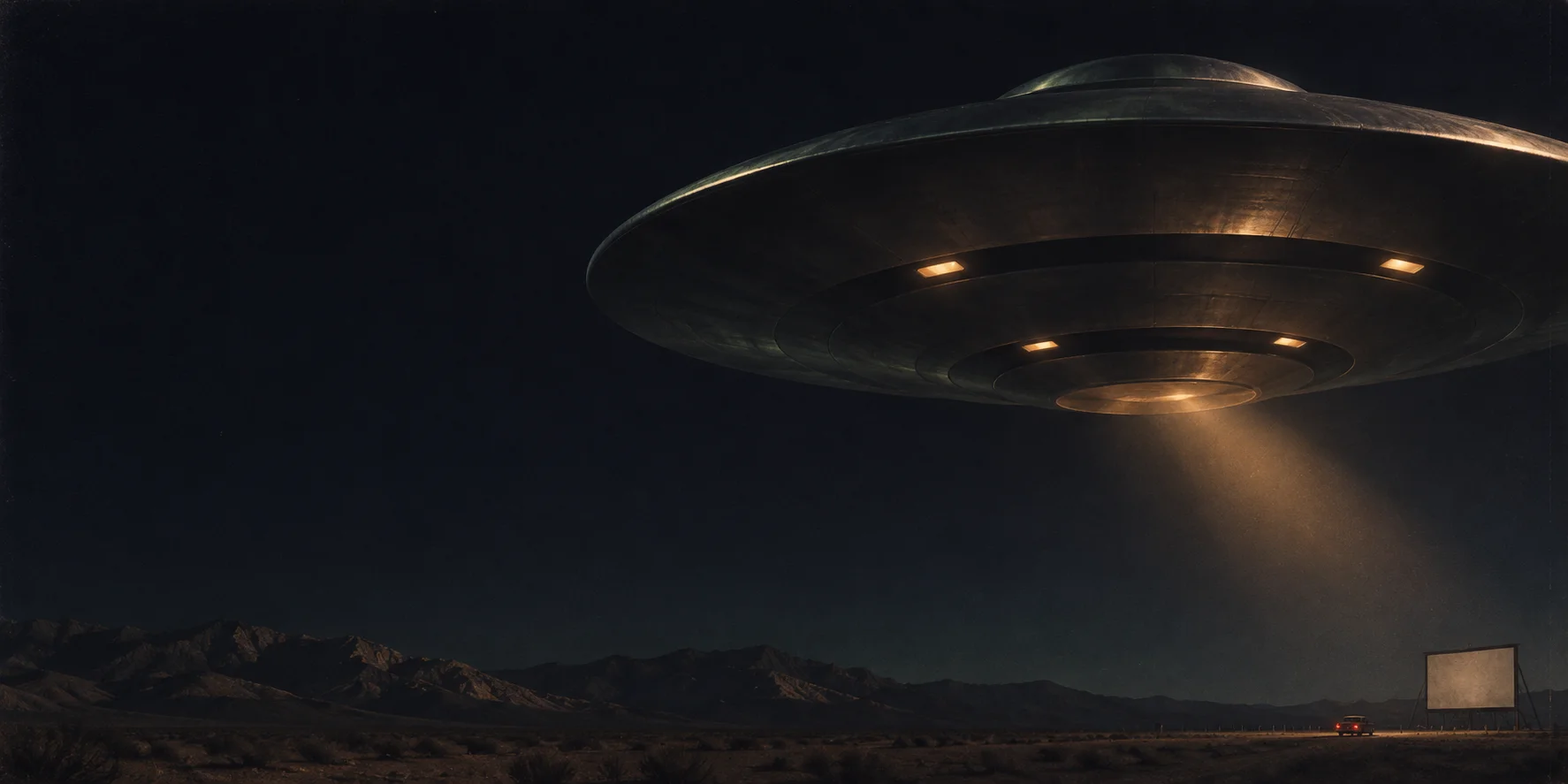
A dark saucer hovers over a desert drive-in after dusk.

The midnight transmission / Reel 001

Did the movies borrow from UFO lore, or did UFO lore borrow from the movies?

Read the first edition
Plate 00. The last screening. Original SF71 concept art.

Station notes

Something’s on the screen.

A saucer hangs above a desert road. The lights go out. Somebody comes back different. A few images have spent decades crossing between movie screens and accounts of strange things in the sky.

SF71 follows those crossings. Each installment starts with a scene, a credit or a recollection, then follows the trail as far as the sources will take it. Sometimes there’s a credit in the opening titles. Sometimes the trail ends with two people telling different stories.

Transmission log

Edition 001 04 installments

A field guide to the familiar strange

Five things to notice the next time the sky interrupts a movie.
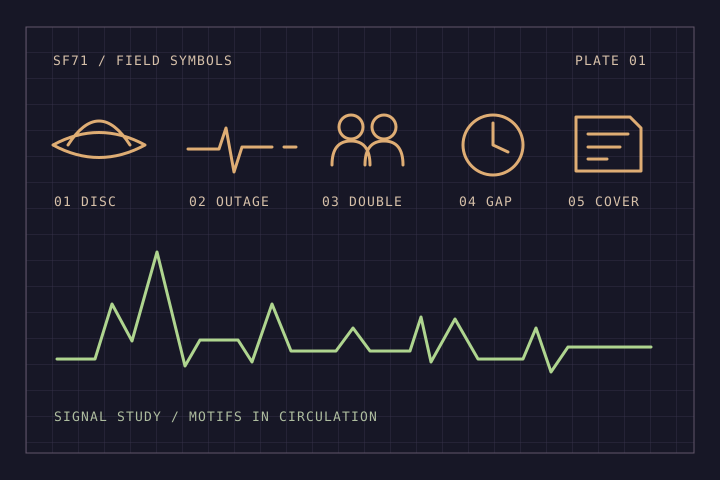
Five diagrams show a flying disc, a power interruption, paired silhouettes, a clock and a covered file.
Plate 01. Five motifs plotted as field symbols. Original SF71 illustration.
Saucers
The disc is recognizable even in silhouette. Compare the craft that lands in public in The Day the Earth Stood Still with the attack craft in Earth vs. the Flying Saucers.
Blackouts
In the 1951 film, Klaatu demonstrates his power by stopping much of the world’s machinery. Note what stops, what stays on and who controls the interruption.
Doubles
In It Came from Outer Space (1953), stranded beings assume human appearances while they repair their ship. A familiar face can conceal a plan to leave as easily as a plan to invade.
Missing time
An unexplained gap gives a story two clocks: the time that passed and the time its witnesses can account for. The Betty and Barney Hill papers offer a place to compare when details entered different versions of their reported 1961 encounter.
Cover stories
Ask who gives the explanation, who hears it and what it leaves out. The Dark Skies interview below is a separate case about a claimed attempt to steer a production.
Earth vs. the Flying Saucers

Here the trail runs from a UFO book to the credits of an invasion picture.

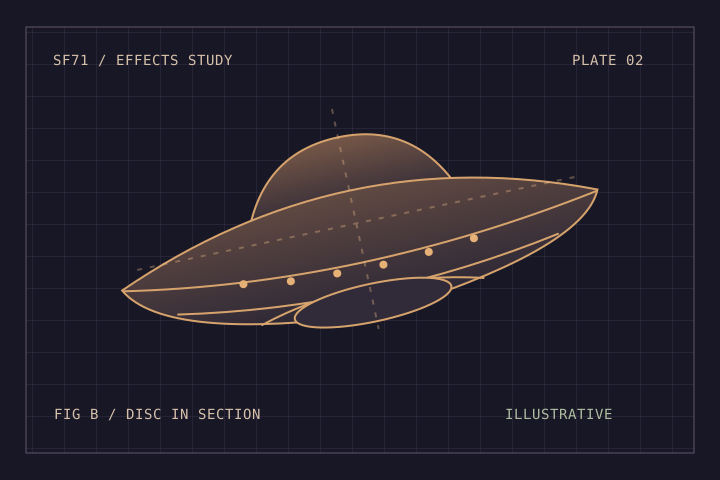
An original technical-style drawing of a tilted saucer with concentric rings.
Plate 02. Disc in section. Original SF71 study inspired by mid-century miniature effects.

AFI records Donald Keyhoe’s 1953 book Flying Saucers from Outer Space as the source that suggested the film. Fred F. Sears directed it, and Ray Harryhausen received a credit for creating the technical effects. That source credit gives us a named route from published UFO lore into a 1956 production.

The movie turns the disc into an attacking fleet. Its Washington, D.C., set pieces belong to the screen story. A comparison with Keyhoe’s book could show which ideas traveled with the credit and which the filmmakers supplied.

The man who stopped the world

Robert Wise directed a first-contact film in which the visitor asks Earth to listen.

The Day the Earth Stood Still sends a human-looking emissary, Klaatu, to Washington with a robot guardian and a warning about human weapons. When he struggles to get a hearing, he interrupts much of the world’s machinery. The interruption makes his arrival impossible to ignore.

Wise directed, Edmund H. North wrote the screenplay, and Harry Bates’s Farewell to the Master was the literary source. The film gives us a dated instance of the public landing, the familiar-looking visitor and the interruption. Compare the short story and the film one element at a time before following those images into later accounts.

The visitor at the Dark Skies premiere

Bryce Zabel and Brent Friedman tell Jesse Michels about a stranger who, they say, knew their pilot.

The premiere-party account. The co-creators recall a man they call JC who claimed Naval Intelligence ties and offered access in exchange for input on future scripts. Their interview records their recollection. His identity, authority and how he knew the pilot remain open questions.

The Spielberg allegation. Friedman attributes a separate story to director Tobe Hooper, who he says told him Spielberg had received and accepted a similar offer. This is Friedman's account of what Hooper said. The interview supplies no firsthand testimony from Spielberg about the alleged offer.

The Herrington dispute. Friedman separately recalls a private conversation with John Herrington about extraterrestrials. Herrington denied Friedman's account in a later Michels interview, and Friedman responded. That dispute concerns the private conversation. The premiere-party account has its own evidence trail.

American Alchemy with Jesse Michels. Premiere-party account at 5:01, later meeting at 45:39, and the Hooper account at 1:04:22. Chapter times follow the publisher’s listing.
Watch on YouTube ↗